The Beauty of Half Moon Side Stone Engagement Rings
The Beauty of Half Moon Side Stone Engagement Rings
Three stones. One story. And a shape that makes the whole ring feel inevitable.
There is a particular kind of ring that people describe as 'complete'. Not in the sense that it has more stones or more metal, but in the sense that every element has an obvious reason to be there: the centre stone, the setting, and the stones beside it all working toward the same visual intention. Side stone engagement rings have always had that quality, but no side stone combination achieves it quite like the half moon.
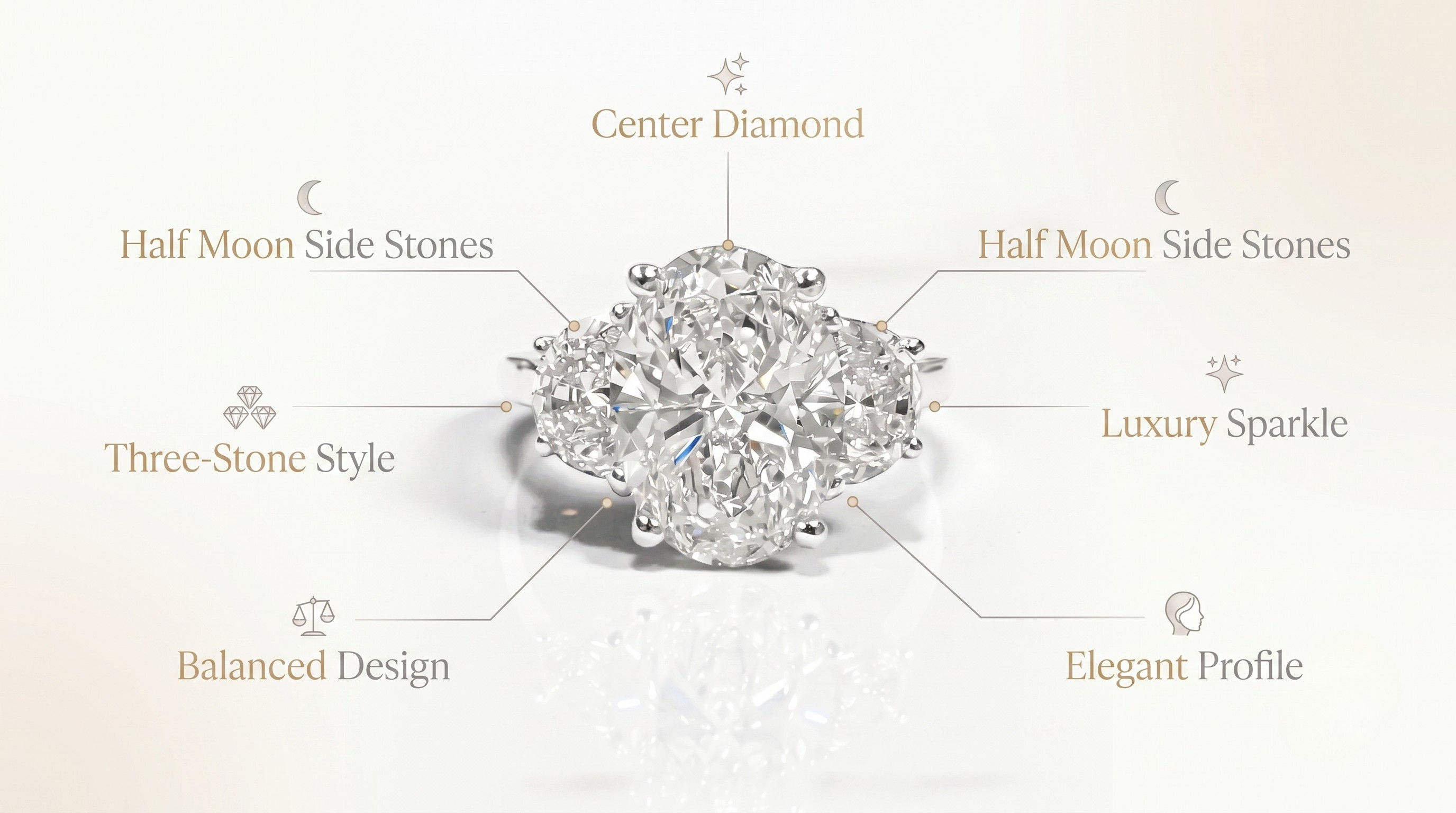
The half-moon side stone is exactly what it sounds like: a diamond cut in a crescent or D-shaped profile that sits flush against the centre stone on either side. It doesn't compete. It doesn't distract. It completes. And it does so with a geometric precision that makes the whole ring look as though it were conceived as a single object rather than assembled from separate decisions. If you've been looking at side stone engagement rings and feeling like something was always slightly off; the side stones too different in shape, the profile somehow unresolved, the half moon is probably what was missing.
What Makes a Half Moon Diamond Different
Most side stones, tapered baguettes, trillions, and round melee sit beside the centre stone as separate elements. They catch light in their own way and add brilliance, but there's always a visual gap, however small, between the centre stone's shape and the side stone's shape. A half moon diamond is cut with a straight edge designed to align precisely with the culet of the centre stone and a curved outer edge that follows the girdle of the setting. The result is that the two elements, the centre stone and side stone, fit together the way two pieces of the same puzzle do. There is no gap. There is no discontinuity. The ring reads as one.
Geometrically, the half-moon shape is one of the most versatile cuts in fine jewellery. That straight inner edge works with almost any centre stone profile, round, oval, cushion, or emerald, without any modification because the straight line of the half-moon kind of adapts to whatever it sits beside. Visually, the curved outer edge gives the side stone a crescent feel, plus that gentle enclosure around the centre diamond, like parentheses in a very elegant sentence, but softer somehow.
Side Stone Engagement Rings and the Half Moon Combination
The question people often arrive with, when they're looking at side stone engagement rings, is whether side stones add to the ring or just detract from it. It's a fair concern. Some side stone combinations do feel like decoration rather than design additional brilliance for its own sake, without any particular visual logic. The half moon solves this because its shape isn't arbitrary. It's specifically designed to flank and echo the centre stone, so the three diamonds together feel like a thought rather than an accumulation.
What side stone engagement rings with half-moon side stones also do, practically, is change the finger impression of the ring. The half-moon stones extend the overall width of the ring across the finger in a way that makes the entire piece look larger without increasing the size of the centre stone.
Half Moon Diamond Ring: The Most Refined Three-Stone Look
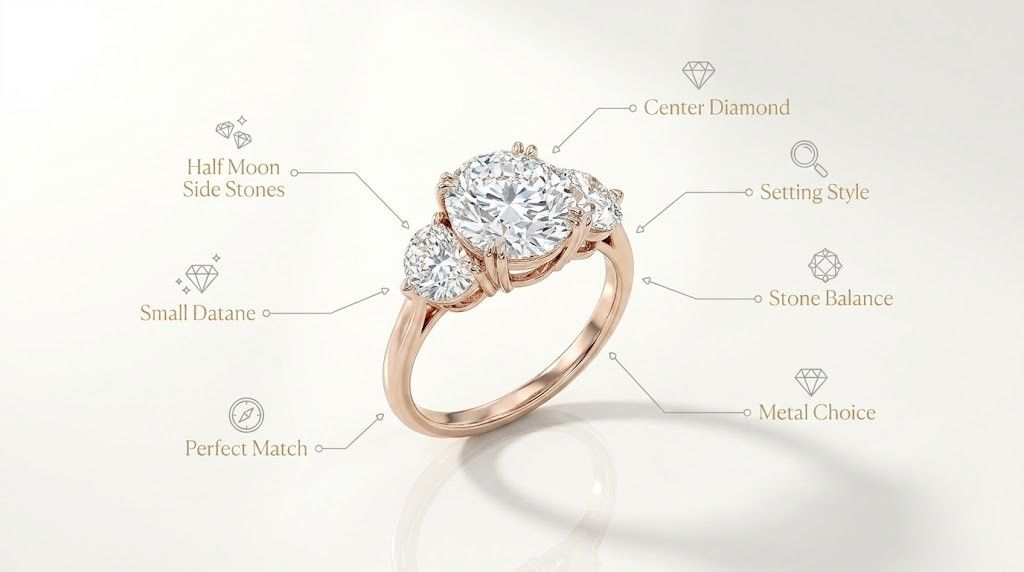
A half moon diamond ring, in the traditional sense, with one centre diamond kind of flanked by two half-moon side stones, all of it seated in one band, is the most sincere way to express this style. The three stones create a single silhouette; it looks wider at the middle than it tapers naturally as it approaches the shoulders, and you end up with a profile that photographs really beautifully from basically every angle. A half moon diamond ring also tends to lie flatter against the finger than rings with more elaborate settings, because the half moon stones don't need height to make their impact; they make it through shape and fit.
Oval Side Stone Engagement Ring: Grace in Three Parts
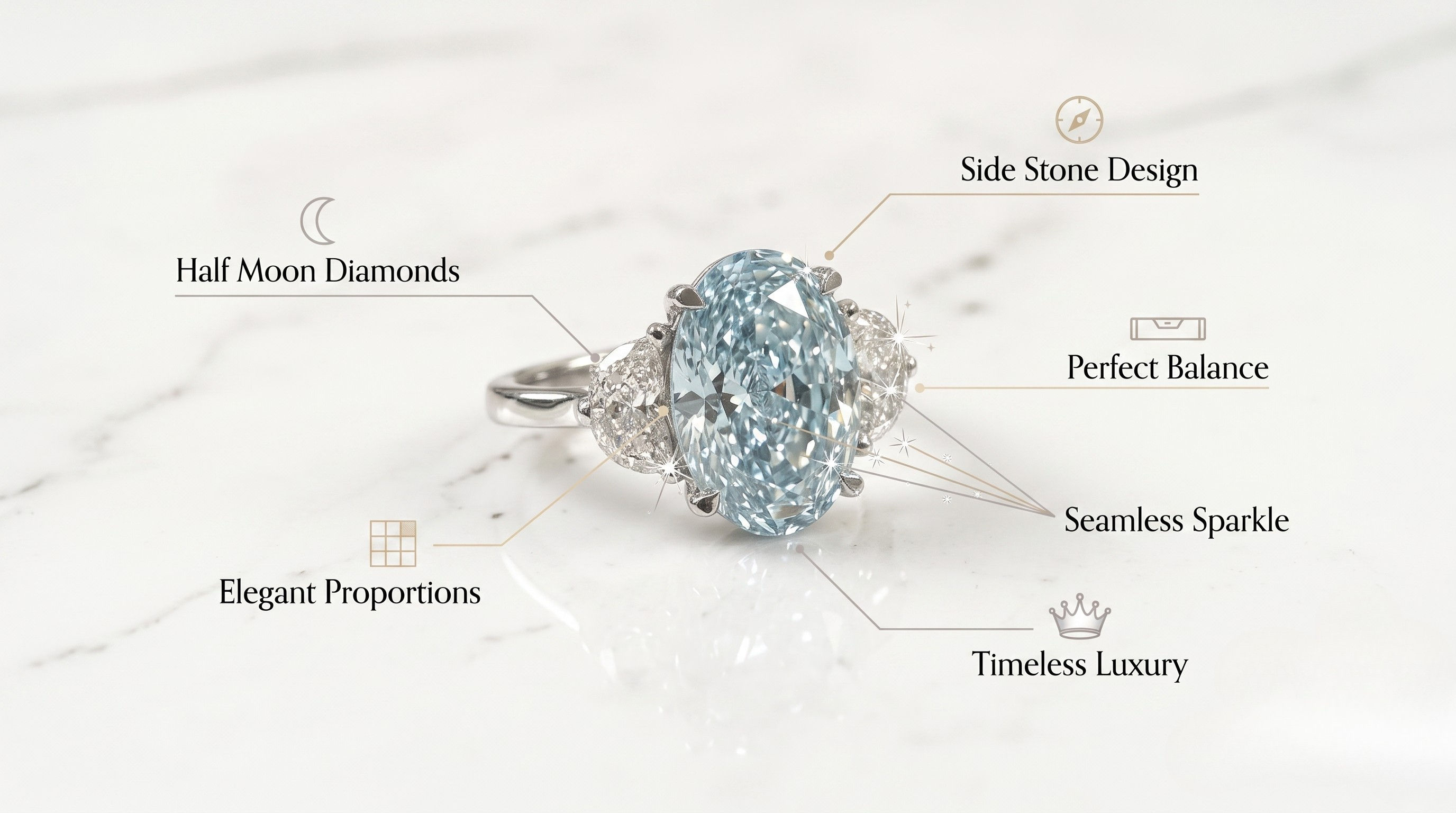
The oval centre stone is kind of where the half-moon side stone really takes over, if you know what I mean. An oval side stone engagement ring with half moons lets the oval's natural grace come through while it's being "held" by stones that guide its elongated look, not cut it up. The straight inner edge of each half moon sits nice and neat with the oval's side outline, and the curved outer edge follows that outer line too, so the whole thing forms a three-part vibe that reads almost like one long stone. Among all oval side stone engagement ring configurations, the half-moon pairing is the one that feels most resolved.
Marquise Side Stone Engagement Ring: Drama in Three
The marquise is the most dramatic centre stone shape available, and a marquise side stone engagement ring with half-moon side stones takes that drama and gives it structure. The half moons' curved outer edges echo the marquise's own pointed tips and sweeping curves, creating a visual rhythm across the ring that feels deliberate and architectural. A marquise side stone engagement ring in this configuration is the kind of ring that attracts attention from across a room, not because it's crowded, but because its geometry is so clearly intentional.
Half Moon Engagement Ring: When the Side Stone Becomes the Style
It's worth noting that the half moon engagement ring isn't always a three-stone composition. Some designs go with one big half moon right there as the centre stone itself, you know, a crescent-shaped diamond, set horizontally, and it becomes the kind of primary focus of the ring. This is kind of rarer and definitely bolder, and it lands squarely in that group of rings that make an unmistakable statement. Whether it's used as the centre stone or, you know, as a side stone, the half moon engagement ring still keeps the same essential quality: a shape that's not like anything else in fine jewellery, instantly recognisable and also deeply considered, even a little bit intentional in a way that you can feel.
Why Side Stone Engagement Rings with Half Moons Simply Feel Right
What unites all of these variations is the same underlying principle. The best side stone engagement rings aren't about adding more to a ring. They're about adding exactly what's needed to make the centre stone feel complete. The half-moon achieves that better than almost any other side stone shape because its geometry isn't approximate; it's precise. It was designed to fit. And when something is designed to fit, you feel it the moment you hold it.
If you've been drawn to side stone engagement rings but haven't yet found one that feels fully resolved, it's worth asking whether you've seen a half-moon pairing in person. The difference between looking at a photo and holding the actual ring is considerable. The way the three stones sit together, the way the curved outer edges catch light differently from the centre stone, and the way the whole piece reads as one object rather than several, none of that comes through in an image.
The half-moon is a side stone for people who notice when something is made well. Side stone engagement rings with half-moon stones reward that kind of attention. They don't announce themselves. They simply look right, in a way that becomes more apparent the longer you look.
Choosing Your Half Moon Side Stone Engagement Ring
- The half-moon was designed to fit. A straight inner edge aligns with the centre stone; a curved outer edge follows the girdle with no gap and no discontinuity.
- It works with almost any centre stone. Round, oval, cushion, or emerald, the straight inner edge adapts without modification.
- It makes the ring look larger. Half moons extend width across the finger without increasing the centre stone's carat weight.
- Oval and half-moon are the most resolved pairings. Three parts that read almost like one long stone, the natural grace of the oval held without interruption.
- Marquise and half-moon are the most architectural. Curved outer edges echo the marquise's sweeping tips, a visual rhythm that feels deliberate.
- The half-moon can also be the centre stone. Set horizontally as the primary diamond, it's rarer, bolder, and unmistakable.
Find Your Half Moon Side Stone Engagement Ring
At Layla Diamonds, every side stone engagement ring is designed around the same principle: the side stones should complete the centre stone, not just accompany it. Come and see a half-moon pairing in person. The difference between a photo and holding the actual ring is considerable.
Frequently Asked Questions
1. What are side stone engagement rings? ▼
They got a centre diamond with smaller stones on the sides, like it adds a little extra sparkle and somehow makes the ring feel more complete in a calmer, fuller way.
2. What is a half-moon diamond? ▼
A half-moon diamond has one straight edge and one curved edge too, sort of like it's making a soft crescent-like vibe. It's not really sharp everywhere, more like a gentle arc, even if you look pretty quick.
3. Do half-moon side stones make a ring look bigger? ▼
Yes, they add that kind of width across the finger, so the whole ring can end up looking bigger without actually increasing the centre diamond size.
4. Do half-moon diamonds look good with oval engagement rings? ▼
Sure, their gently arched form feels right next to an oval diamond and kind of pulls everything into a calm, even kind of balance; it works really well.
5. Are side stone engagement rings good for everyday wear? ▼
Yes, I mean especially when the stones are set securely. They're kind of elegant, practical, and pretty effortless to wear day to day. Also, it feels like they're low effort without looking plain.


Comments
Post a Comment