Everything You Need to Know About Two-Tone Engagement Rings
Everything You Need to Know About Two-Tone Engagement Rings
Two metals. One ring. A choice that says more about you than you might expect.
There's a thought that kind of runs through the best design decisions: if two things are pulling at each other, then, if you handle it right, they can end up making something more compelling than either one would manage alone. Two-tone engagement rings are made with that same idea. Two metals, yellow and white gold, rose and white, yellow and rose, all woven into one single piece of jewellery that holds the warmth of one side and the sharp, cool accuracy of the other at the same time. The outcome isn't a compromise, or not really. It's a contrast, only this time chosen on purpose.
The appeal is kind of straightforward once you've held one. The stone rests in a different metal than the band, or the shoulders shift from one tone to another, and then the ring gets this visual depth that a one-metal piece just doesn't offer. Two-tone engagement rings have been around for decades, but their recent surge in popularity actually shows something tangible: people are picking rings that feel authentically personal, not merely what's expected.
Two-Tone Engagement Rings and Diamond Wedding Rings for Women
When it comes to diamond wedding rings for women, the two-tone approach solves a problem that single-metal rings can't: what to do when you love the warmth of yellow gold but want the diamond to sit in the cooler, brighter setting that white gold provides. The answer is both. A yellow gold band with a white gold crown, the setting that holds the stone, is the most classic two-tone combination, and for good reason. The gold warms the hand; the white gold lets the diamond do its work without any colour interference beneath it.
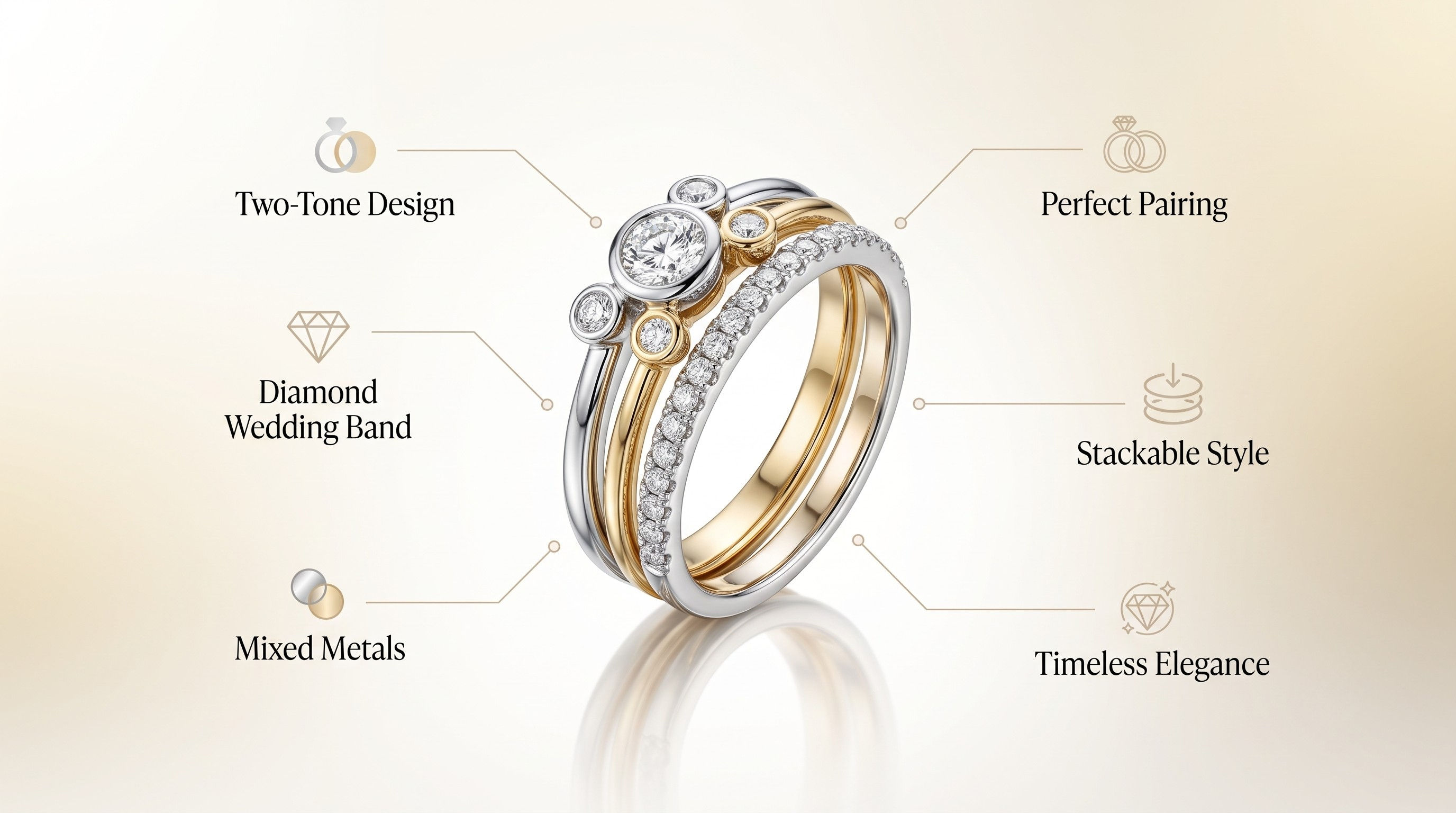
The metal combinations you can get for two-tone engagement rings are wider than most people think, or at least that's what they usually say. Yellow and white are the classic, kind of the safe path. Rose and white feel softer, more romantic in a quiet way. Yellow and rose are a bit more uncommon, and it comes off warm; it's also a less obvious pick that's still gaining traction with folks who already know exactly what they want. Each pairing tells a slightly different story. So the right selection depends on the person wearing it, entirely.
- Yellow and white gold: The classic combination, warm band, cool crown.
- Rose and white gold: Softer, more romantic in a quiet way.
- Yellow and rose gold: Uncommon, warm, and gaining traction with people who know exactly what they want.
Oval Cut Engagement Rings in Two-Tone Settings
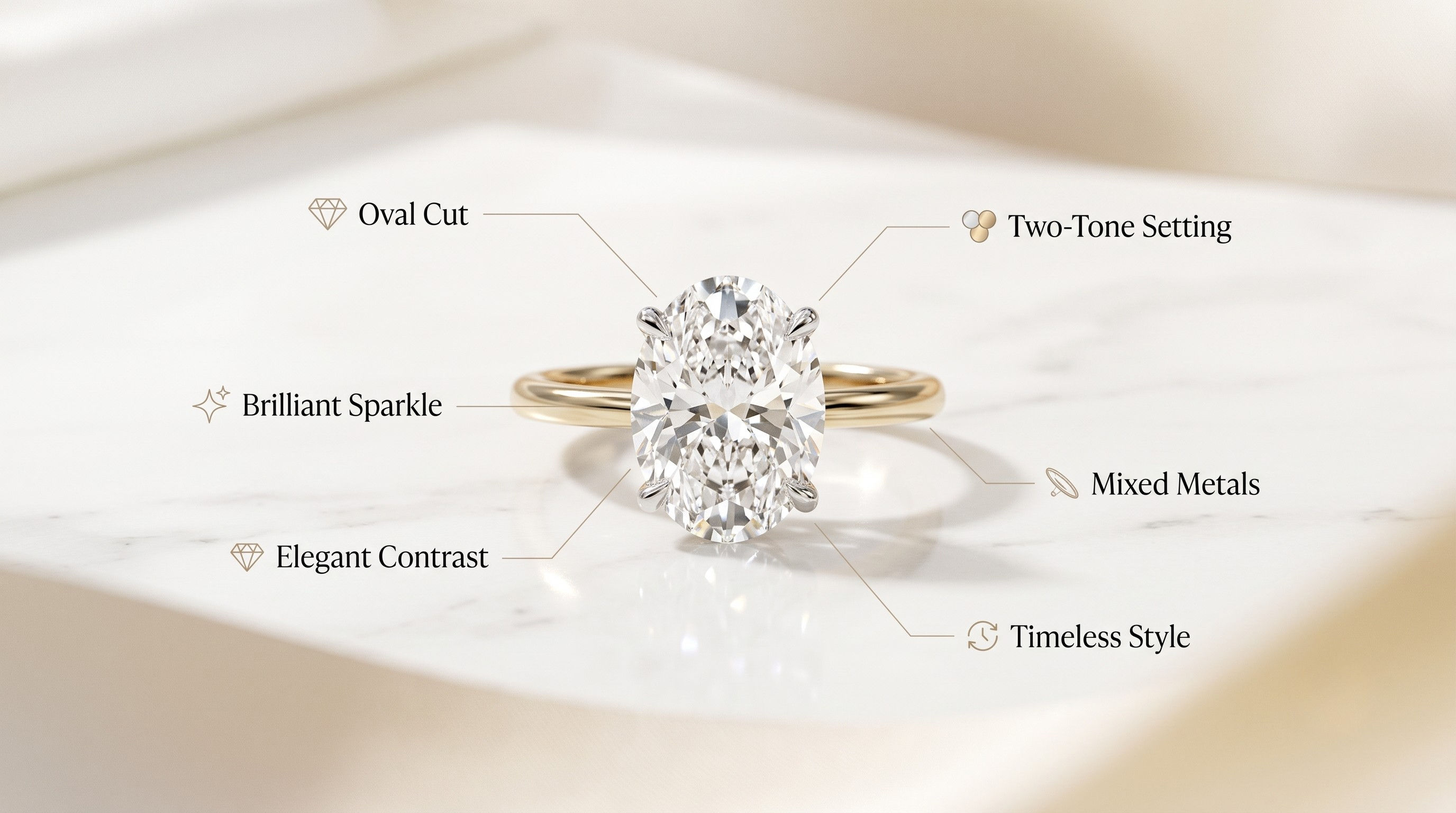
Of all the stone forms that really enjoy a two-tone setting, the oval is maybe the most naturally made for it. Oval cut engagement rings already carry that stretched silhouette, and it seems to gather light in a slightly different way from every angle, or even just a small change in how you're standing. Put the stone into a two-tone setting, and it just feels layered. Choose a white gold crown to push the diamond's brilliance as far as it can go, then add a yellow or rose gold band to keep everything grounded, a bit warmly on the hand. From above, it almost looks like white, and then you catch the diamond. From the side, you suddenly see the gold show up, like the ring has a second personality. It's never entirely the same ring twice.
This interplay of light and metal is the quiet magic of two-tone engagement rings. They reward looking closely. The more attention you give them, the more they give back.
Hidden Halo Engagement Ring: Two-Tone's Quiet Companion
A hidden halo engagement ring in a two-tone setting is kind of one of those pairings where each part makes the other feel a bit more special, even if that sounds maybe too dramatic. The hidden halo itself, a circlet of smaller diamonds placed just under the middle gemstone, is basically a feature you only notice when you lean in. From above, it stays almost invisible, yet it still gives that little extra sparkle, like a private secret. And with a two-tone setting, the way it's arranged can look especially clean: the discreet stones are often in white gold, while the band goes in yellow or rose gold, so there's a warm separation between the ring's body and the brilliant crown on top. It comes across as subtle, refined, and yes, completely on purpose.
Heart-Shaped Diamond Ring: Romance in Two Metals
A heart-shaped diamond ring in a two-tone setting is a little more unusual choice, and that's kind of why it fits so well for the right person. The heart shape already brings that pretty direct romantic charge, but the two-tone setting adds another visual layer, more refined, so it doesn't read as only sentimental. A rose gold band beneath a white gold crown is especially beautiful in this exact setup, you get the blush warmth of the band, the cool precision of the crown, and a heart shaped stone that's always catching light right in the middle between them.
3 Carat Engagement Ring: Two-Tone Handles the Scale
At larger carat weights, the two-tone setting earns its place even more. A 3-carat engagement ring is already a statement; a stone with that kind of presence doesn't need much help commanding attention. What a two-tone setting does here is balance that scale with warmth. The white gold crown holds the stone with technical precision; the gold band grounds the whole piece so the ring feels rich rather than cold. Scale and warmth, working together.
Lab Grown Diamond Engagement Rings in Two-Tone Settings
There's really no good reason lab-grown diamond engagement rings can't be two-tone, and honestly, in practice, the combo is one of the most popular picks at Layla Diamonds. A lab-grown stone is chemically and visually identical to a mined one, so it's not like you're missing something, or that the sparkle somehow "counts less". Put it into a two-tone ring, say 18ct yellow and white gold, and you end up with a piece that has just as much character, craft, and longevity as anything made with a mined diamond. If anything, the savings you get from choosing a lab-grown stone can go toward a better quality metal pairing or even a larger centre stone.
Men's Engagement Rings: Two-Tone Has a Place Here Too
The talk around men's engagement rings has moved in a pretty noticeable way, and honestly, the two-tone strategy sits well inside all that. A low-profile gemstone, placed in white gold and then carried by a yellow or rose gold band, comes across as grounded and personal, not loud. It's like two metals don't wrestle for attention; they just give contrast. For guys who want an engagement ring to be on their finger but also feel theirs unmistakably, the two-tone setting gives you a design language that's harder to track down in a one-metal choice.
Why Two-Tone Engagement Rings Keep Getting More Popular
Part of the answer is practical, yeah. Two-tone engagement rings work with almost everything in your jewellery collection. If you wear yellow gold earrings and you also keep a white gold watch on your wrist, a two-tone ring doesn't really have to pick sides between them. It kind of speaks both languages at once. That flexibility matters more than most people think, until you are wearing the ring every day, and it quietly goes with everything else.
But the deeper reason is harder to pin down. There's something about two-tone engagement rings that feels, for the right person, more honest than a single metal option. Not because single-metal rings are dishonest, but because the two-tone ring wears its complexity openly. It doesn't try to be just one thing. For people who don't see the world in single colours, that resonates.
The best two-tone engagement rings are the ones that, when you hold them, feel like they already know something about who you are. The metal combination isn't accidental; it's a choice made with intention, and that intention is visible every time you look at your hand. That's what keeps bringing people back to this style, and what keeps it feeling relevant regardless of what's trending in any given season.
Choosing Your Two-Tone Engagement Ring
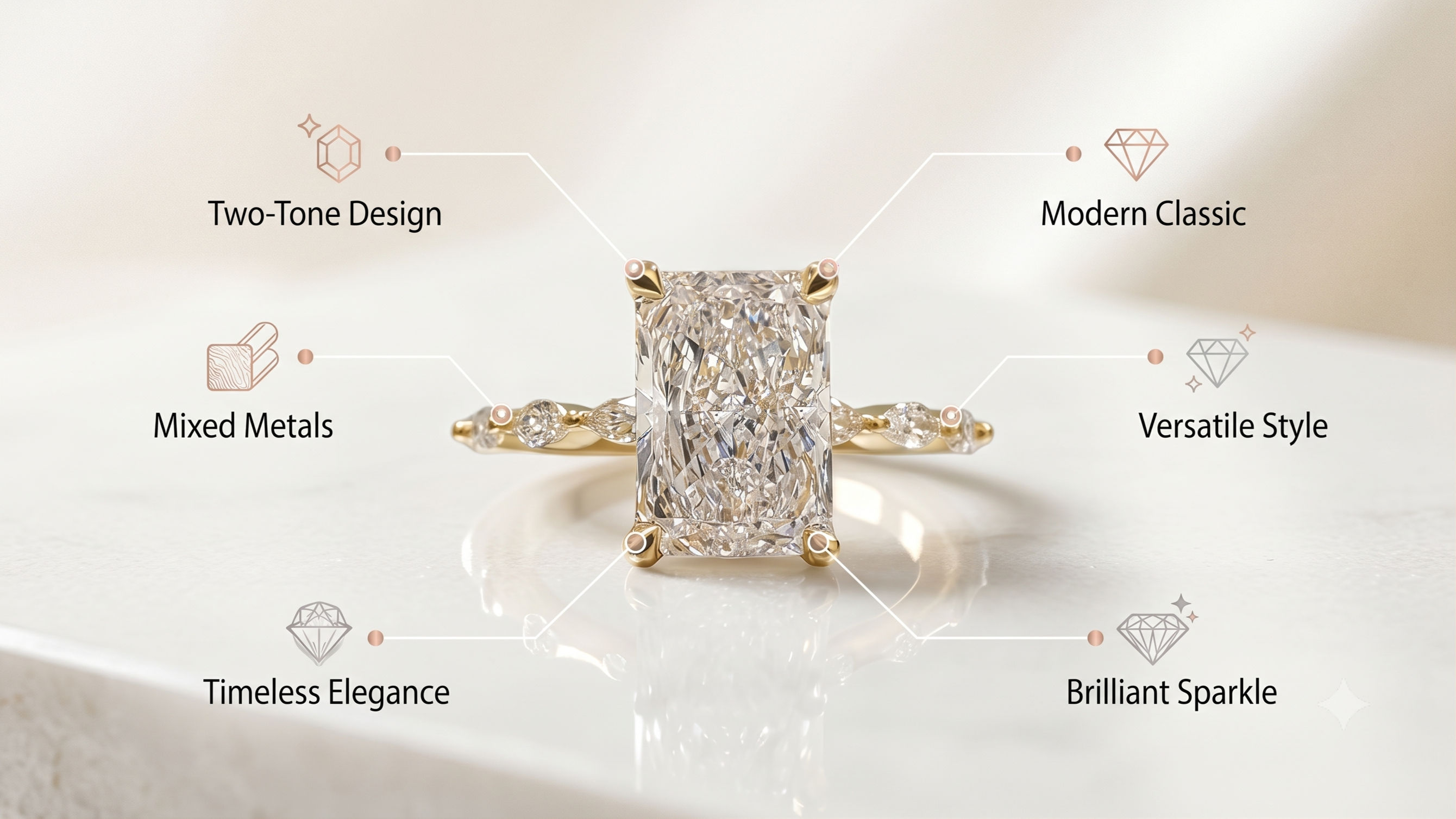
- It's a contrast, not a compromise. Two metals chosen on purpose, the outcome is more compelling than either one alone.
- Yellow and white are the classics. Warm band, cool crown, the diamond gets a bright white setting while the hand stays warm.
- Oval is the most naturally made for it. The stretched silhouette layered with two-tone depth creates a ring that's never entirely the same twice.
- Hidden halo adds a quiet secret. White gold halo stones beneath the crown, warm gold band below, subtle, refined, completely on purpose.
- Lab-grown works just as well. Same sparkle, same character, and the savings can go toward a better metal pairing or larger centre stone.
- It goes with everything. Yellow gold earrings, white gold watch, two-tone speaks both languages at once.
Find Your Two-Tone Engagement Ring
At Layla Diamonds, we design every ring with intention. If two-tone engagement rings have caught your attention, come and hold one in person. Some things only make complete sense once you're actually wearing them.
Frequently Asked Questions
1. What are two-tone engagement rings? ▼
Two tone engagement rings are rings that mix two distinct metals, like it's some kind of blend, so the whole thing ends up looking deeper and more alive. It's a pretty nice alternative to the usual single-metal style.
2. Are two-tone engagement rings still in style? ▼
Yeah, they still are. They feel timeless, but also kind of fresh , because the contrast gives a modern vibe without trying too hard.
3. Do two-tone engagement rings go with different jewellery colours? ▼
Definitely. They generally match well with both yellow gold and white gold jewellery, so you can wear them with whatever you already have, and it still looks intentional.
4. Do lab-grown diamonds look good in two-tone engagement rings? ▼
For sure, lab-grown diamonds bring that same shimmer and sharpness as the mined ones , so in a two tone setting, they look pretty bold, like really noticeable, in a good way.
5. Who should choose a two-tone engagement ring? ▼
Anyone who likes a less ordinary design. If you want something that stands out a bit, but not in a loud way, then this type of ring fits.


Comments
Post a Comment