Oval Spaced Band vs Traditional Wedding Bands: Which Is Right for You?
Oval Spaced Band vs Traditional Wedding Bands: Which Is Right for You?
A client came into the store last month, certain she wanted a plain gold band. Twenty minutes later, she left, having ordered an oval spaced band instead.
Nobody thinks much about wedding bands until they're standing in front of a tray of them, and then everything they thought they wanted gets a bit negotiable. Two styles keep coming up with our clients lately: the oval spaced band and the traditional wedding bands that have basically been around forever. Put them side by side, and they don't actually have that much in common, even though both are, at the end of the day, still just wedding bands doing the same job on someone's hand for the rest of their life.
What Is an Oval Spaced Band, Really?
Take a normal eternity band and pull the diamonds apart a little. That's most of what an oval spaced band is. Oval-cut stones set with real space between each one instead of one packed row. The gaps aren't a mistake somebody didn't fix; they're the whole reason the style exists. Light hits each stone individually instead of blurring together, so as the ring moves, you get this rhythm running around it rather than one flat shimmer.
Pavé setting or channel setting aims at the opposite, perfect uniformity without any gaps at all along the row. Each stone has its own moment there. Interestingly enough, all the gaps created between the stones create a sensation of lightness of an oval spaced band, even though it still contains the same weight of diamonds. Many customers come to our shop and order wedding bands that remain classic yet are different from those worn by the bride's sisters or best friends.
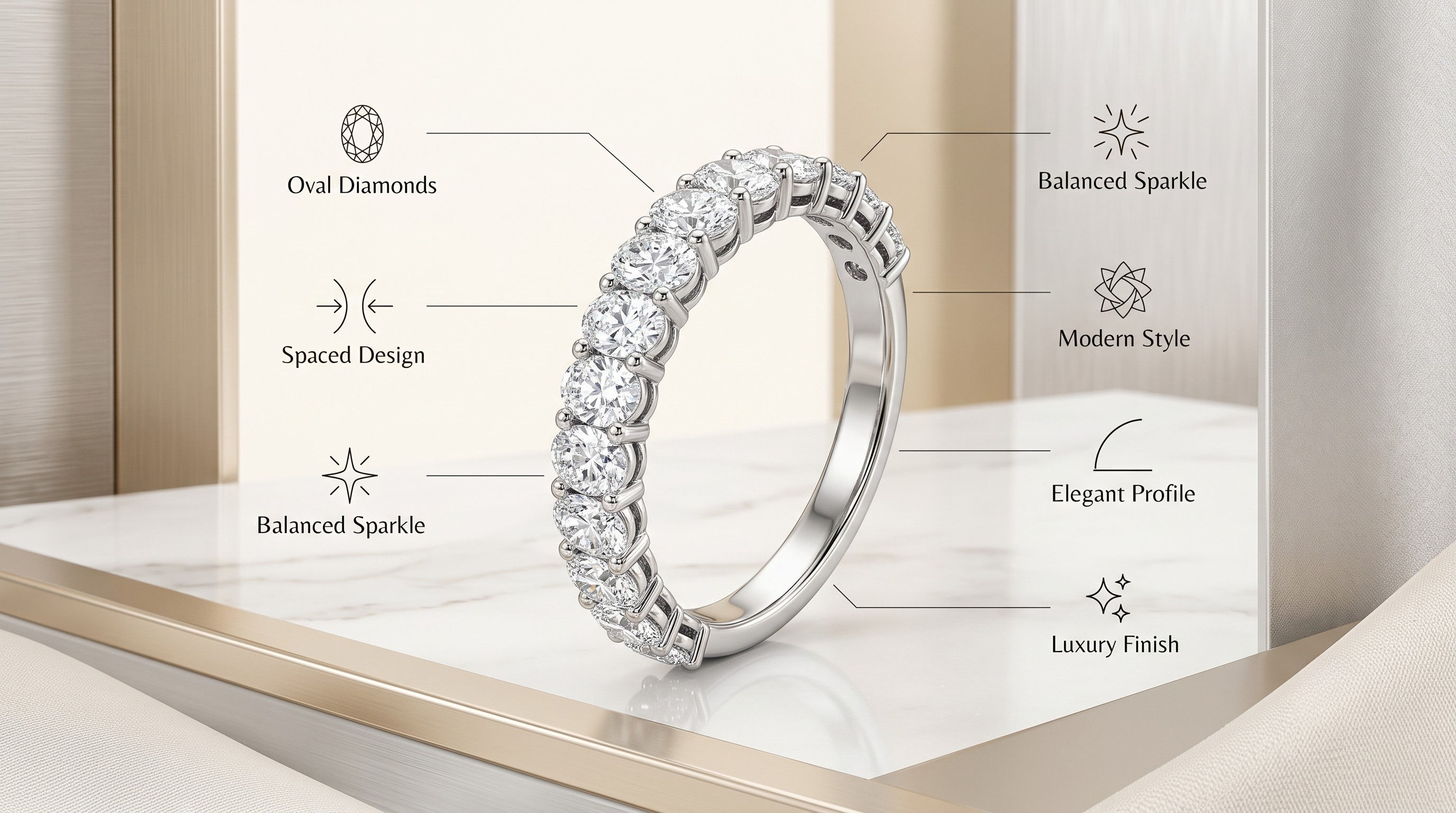
There's a practical angle to the oval-spaced band, too, one that people rarely ask about but should. Spaced settings snag less on jumpers and scarves than a tight row of prongs does, just because there's more metal breaking up the surface. Not life-changing, but if you're the type who's constantly pulling clothes over your head or working with your hands, it's the kind of thing you notice within the first month, not the first day.
Out of all the wedding bands we carry, the oval spaced band is probably the one people ask the most follow-up questions about, mostly because it looks so different from anything they've seen before.
Traditional Wedding Bands Have Been Fine for a Few Hundred Years, Actually
Nobody's really improved on a plain, polished band. Or a thin pavé row. Or a soft dome profile, for that matter. Traditional wedding bands aren't trying to impress you, and that's the whole point of them; they sit there quietly every day and let the engagement ring do the actual talking. Most of the traditional wedding bands we sell haven't changed in design for decades, and that's exactly why people still ask for them.
Men's Wedding Bands
Grooms shopping for men's wedding bands mostly land in "understated" territory and stay there. Brushed or matte finish, warm gold that won't clash with whatever ring his partner picked out. Men's gold wedding bands in particular tend to be the default here, since that warm tone ages well and doesn't need much upkeep. A lot of the men's wedding bands we fit are actually wider than people expect once they try one on, since a bit of extra width tends to sit more comfortably than a razor-thin one.
Some want their men's gold wedding bands heavier or a bit more sculpted, but even that version still reads as quiet, just quiet with more weight behind it. What surprises people is how much time is spent on width and comfort fit rather than looks, with men's gold wedding bands specifically. We'll have a groom try on four or five men's wedding bands before he lands on the one he actually stops noticing on his hand.
Wedding Bands for Women
When it comes to wedding bands for women, most tend to go for a slim diamond row or a curved shape to sit flush against their engagement ring. It's less a "safe" choice than the one you're allowed to stop thinking about the moment it's on your finger. If you already stack rings on that hand, signet rings, thin bands, or whatever traditional wedding bands for women usually slot in without fighting anything else you're wearing.
We've noticed that wedding bands for women get chosen with a lot more attention to how they'll sit against an existing engagement ring than men's do, probably because women are more likely to be wearing two rings stacked together every day rather than just one.
Presence vs Restraint: The Short Version
One ring wants to be looked at. The other one is actively trying not to be. That's really the whole split, and neither approach is objectively better; they're just built for different people or, honestly, different points in the same person's life.
| Factor | Oval Spaced Band | Traditional Wedding Band |
|---|---|---|
| Light behaviour | Individual rhythm: each stone catches light separately | Uniform shimmer across a packed row |
| Visual character | Presence wants to be looked at | Restraint, quietly lets the engagement ring talk |
| Snagging | Less, more metal breaks up the surface | More likely with tight prong rows |
| Pairs with solitaire | Better than you'd think, shares the clean, uncrowded look | Classic pairing, always works |
| Best for | Those who want character and motion in their band | Those who want to stop thinking about it once it's on |
Metal Matters More Than People Expect
Gold shifts as you wear it, developing a soft patina that some people love and others take back to be polished every year or two without fail. Platinum wedding bands, on the other hand, stay white on their own with no plating involved and hold up better against scratches, which is worth knowing if your hands are doing something physical most of the day. We tend to recommend platinum wedding bands to anyone with rough hands, who works with tools, or just doesn't want to think about maintenance at all. Platinum wedding bands do cost more upfront, but a lot of people find that trade-off worth it once they know they won't be back in a few years for replating.
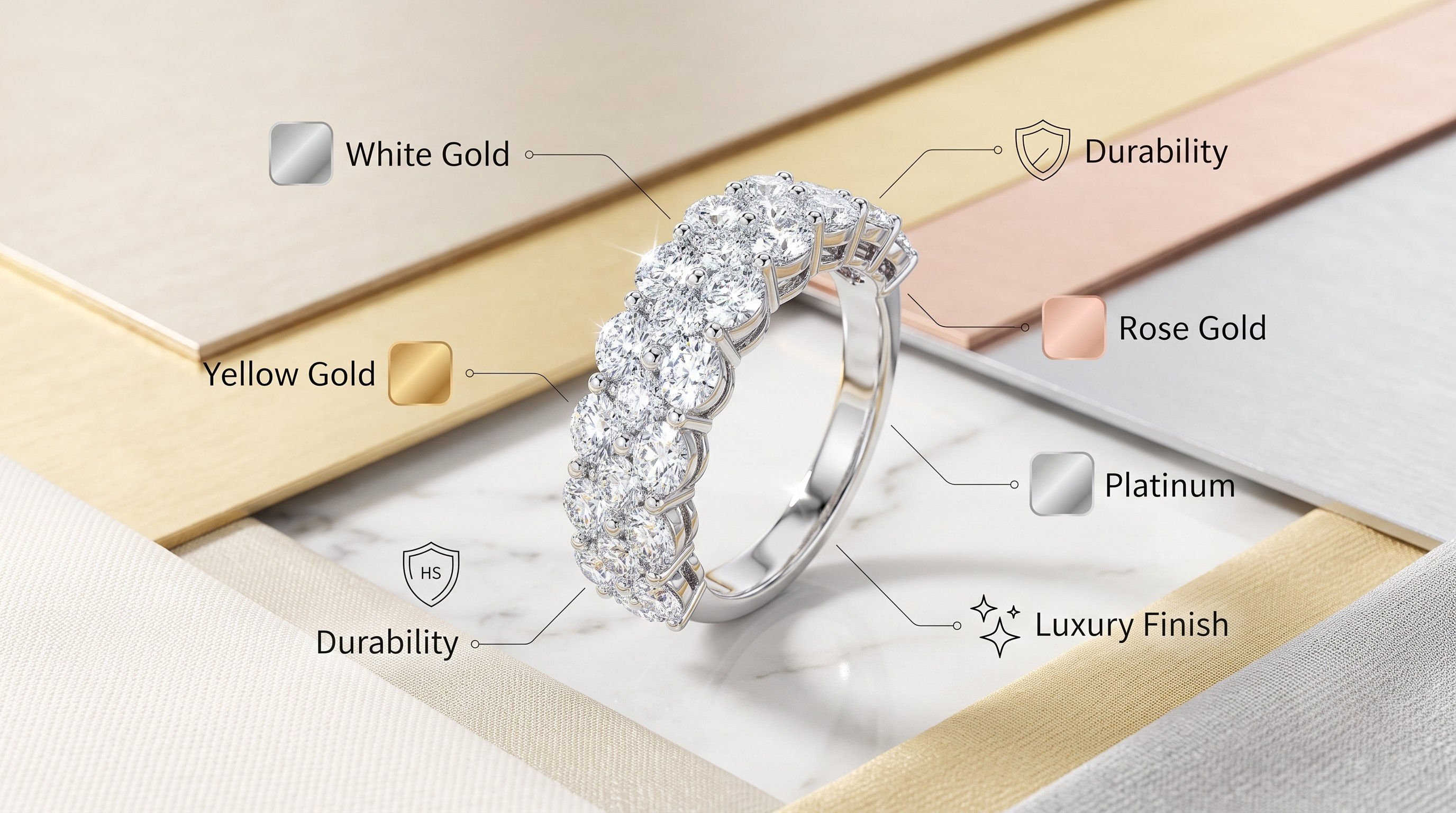
Rose gold wedding bands are worth a look if you want warmth; they suit most skin tones and show through the gaps of an oval spaced band in a way they can't on a tightly packed row. Rose gold wedding bands have become one of our most requested options over the last couple of years, especially among people who find plain yellow gold or white metals a bit too safe. If you're torn between metals entirely, rose gold wedding bands tend to be the easiest compromise, since they read as neither strictly warm nor strictly cool.
Lab Grown Diamond Wedding Band: Same Fire, Better Value
When the origin of the stone means less to you than the sparkle of the ring, a lab-grown diamond wedding band will provide you with the same fire and brilliance without costing you as much money. More couples are opting to get a lab-grown diamond wedding band without any reservations about their choice due to both the cost and its reduced impact on the environment. Moreover, with a lab-grown diamond wedding band, you have the added advantage of going with a bigger carat size without having to pay too much.
So, Which One Actually Fits You?
Don't dwell on how it will look in pictures on day one, but instead focus on how it will feel to wear in five years. If you have a thing for texture and a little bit of motion that goes nicely with solitaire or hidden halo, then it will be the oval spaced band. If you want something more discreet, stick with classic wedding bands.
Plenty of couples split it anyway: one in a plain brushed band, the other in an oval spaced band, neither one trying to match. There's no unwritten rule that says your wedding bands have to look like a set. What actually matters is that each ring feels right on the hand it's living on.
Choosing Your Wedding Band
- The oval spaced band is about rhythm. Gaps between stones let light hit each one individually, giving motion and character rather than flat shimmer.
- Traditional bands are about restraint. They sit quietly every day and let the engagement ring do the talking, unchanged in design for decades, and still asked for.
- Platinum stays white without plating. Worth recommending to anyone with rough hands or who doesn't want to think about maintenance.
- Rose gold is the easiest metal compromise. It suits most skin tones and shows beautifully through the gaps of an oval spaced band.
- Lab-grown diamonds give the same fire. Same brilliance, reduced environmental impact, and more carats for less money.
- They don't have to match. Think about how it will feel to wear in five years, not how it looks in pictures on day one.
Come Find Yours
All our creations are created by hand, crafted from handpicked and ethically sourced stones. They are available for reasonable prices without any hidden charges imposed through intermediaries. Should you be looking for a creation with some action going on, such as the oval spaced band, or a simpler one, like the classic wedding bands, our specialists based in London will provide personal assistance in selecting both based on the real essence of your life rather than its appearance on the day you put it on.
Frequently Asked Questions
1. Is an oval spaced band more expensive than a traditional wedding band? ▼
Not by default, it's the carat weight and metal driving the price, not the gaps between stones.
2. Can an oval spaced band be resized after purchase? ▼
Sure, we can; we do it fairly often without any real trouble.
3. Does an oval spaced band work well with a solitaire engagement ring? ▼
It pairs better than you'd think; both share that same clean, uncrowded look.
4. How do I clean an oval spaced band at home? ▼
Honestly, just soap, warm water, and an old soft toothbrush.
5. Are there still people who like traditional wedding bands in 2026? ▼
As one of our best-sellers, if that means anything to you.


Comments
Post a Comment