Asscher Cut Diamond: Why Is This Vintage Shape Making a Modern Comeback?
Asscher Cut Diamond: Why Is This Vintage Shape Making a Modern Comeback?
Not every diamond is built to flash. Some are built to hold you still.
Most diamonds are engineered to catch the eye before the mind arrives. Seventy-two facets doing the work of ten, throwing light outward in every direction, dazzling before anything slower than dazzle gets a chance to happen. The asscher cut diamond does the opposite. It draws you inward. Its facets are broader, fewer, and arranged in concentric geometric steps rather than the radiating triangles of a round brilliant, creating a hall of mirrors effect that pulls light down into the stone rather than bouncing it outward. You don't look at an Asscher. You look into one.
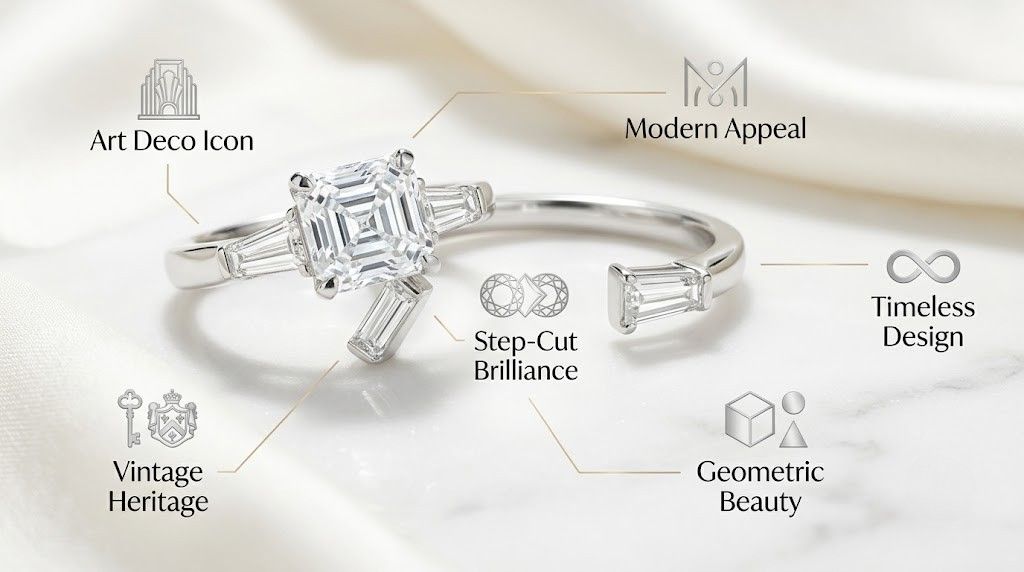
The cut was created in 1902 by the Royal Asscher Diamond Company of Amsterdam, and honestly, its design language sits mostly in the early twentieth century: that sharp geometry of Art Deco and the architectural confidence of a time when ornamentation was supposed to have structure. An asscher cut diamond from that period keeps the same sort of visual logic as a Bauhaus building or a Van Cleef Art Deco brooch: nothing extra, everything placed with intention. That particular quality is exactly why it has been so compelling again.
The Asscher Cut Ring: A Shape Built on Geometry and Patience
Technically, an asscher cut ring is built around a step-cut diamond with a square outline, cropped corners, and a high crown that creates that characteristic deep, windowed look. The cropped corners distinguish it from a princess cut, which is also square but faceted to produce brightness rather than depth. The Asscher's broad, open table facet is like a window in a building; it frames the interior rather than reflecting the exterior, which is a fundamentally different relationship between the stone and the observer.
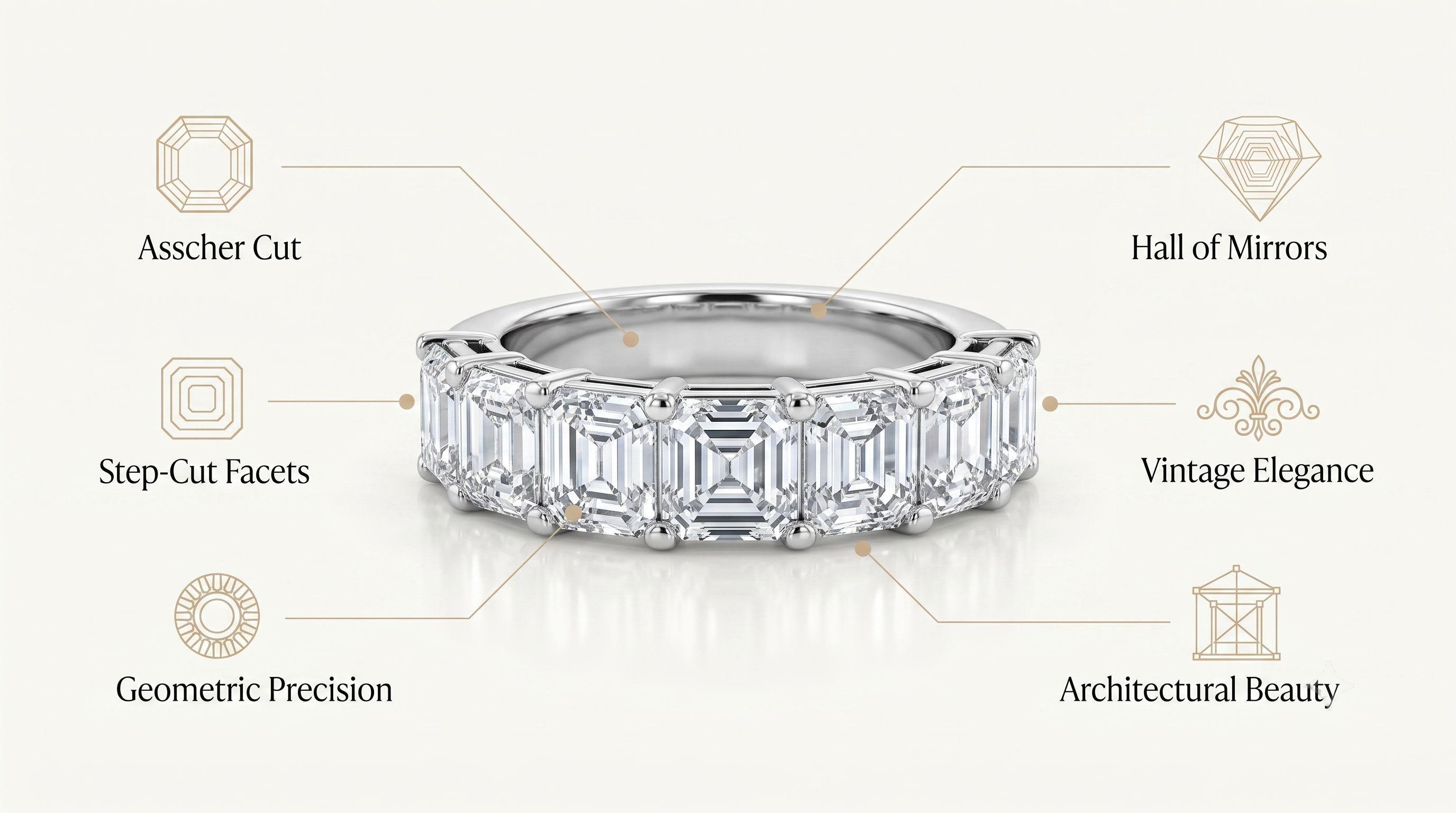
The Asscher cut ring rewards a clarity of stone that other cuts can forgive. Because its facets are so open and so few, inclusions that might be invisible in a round brilliant become visible in an Asscher at equivalent clarity grades. This means buying an Asscher with genuine care about stone quality, which is its own kind of discipline. People who understand diamonds often find this requirement part of the appeal rather than a drawback.
The Asscher Cut Diamond Ring: How It Caught the World's Attention Again
The modern comeback of the Asscher cut diamond ring is a bit cultural and a bit cyclical, you know. Fashion has been drifting toward more restraint, clean lines, almost architectural silhouettes, and that general feeling that deliberate, understated decisions have more weight than the maximalist ones. The Asscher fits that shift perfectly. It is, by design, the anti-round brilliant: where the round brilliant maximises flash, the Asscher maximises depth; where the round brilliant announces itself, the Asscher invites approach.
There is also a growing awareness that the step-cut family, emerald, baguette, and Asscher represent a different philosophy of diamond cutting entirely, one that predates the modern obsession with brilliance grades and fire percentages. An Asscher cut diamond ring is the choice for someone who has looked at everything else and decided they want something with a different kind of presence. Not louder. Just deeper.
Asscher Cut Engagement Rings: Finding the Right Setting
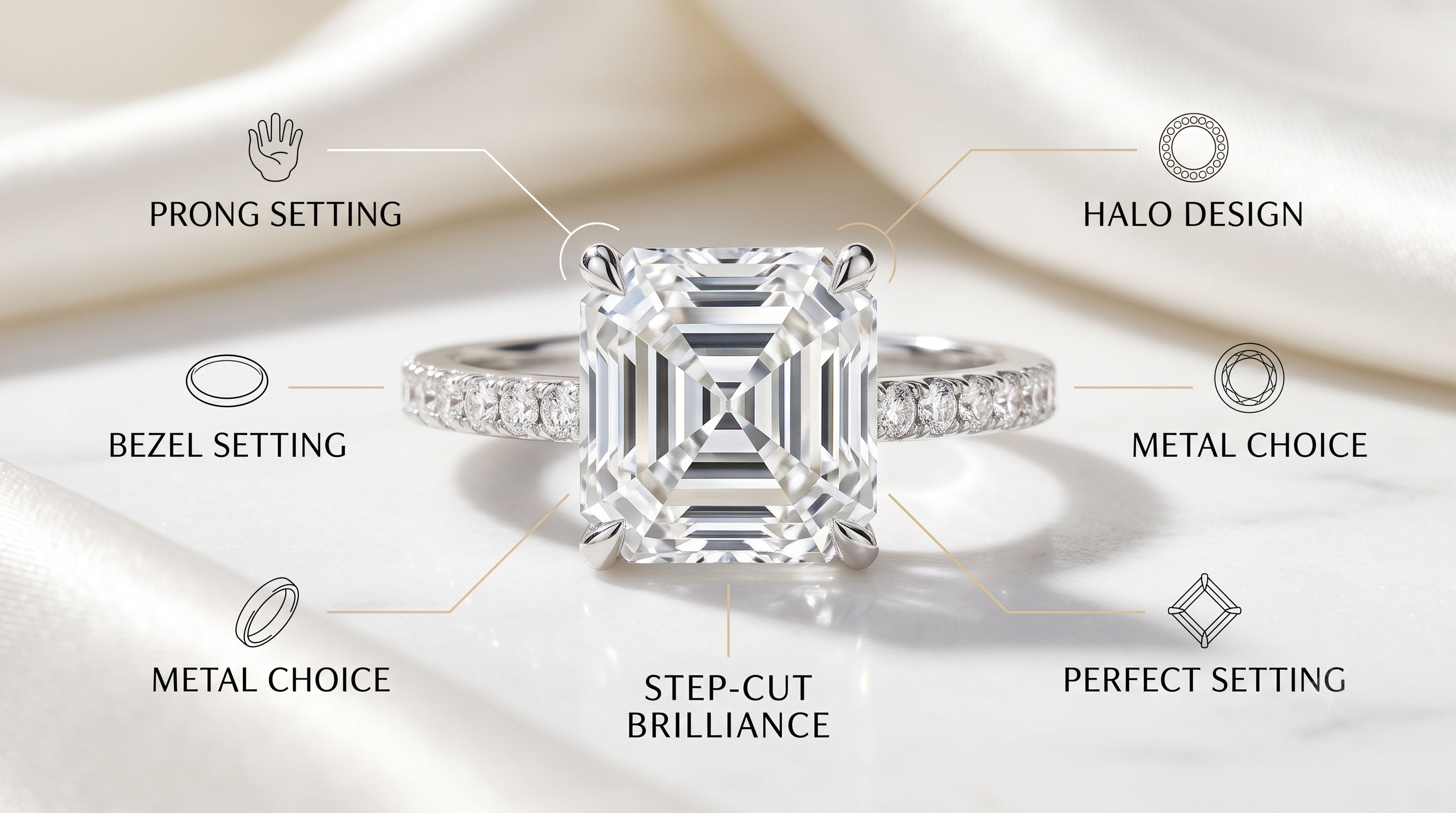
The setting matters enormously for asscher cut engagement rings because the stone's square outline and cropped corners create a specific visual logic that some settings complement and others disrupt. A four-prong setup at the corners works really well; the prongs kind of follow the actual geometry of the stone, so they don't interrupt it too much, or at least it feels that way. A bezel option is also good, especially in yellow gold, where the warm metal cradles the stone's depth and gives the whole band a gently retro vibe. Asscher cut engagement rings usually look their best in settings that allow the stone to breathe, not those that crowd it in.
Diamond Shoulder Engagement Ring: The Asscher with Added Architecture
A diamond shoulder engagement ring pairs the Asscher centre stone with pavé or channel-set diamonds running along the band shoulders. This creates a more elaborate profile without disrupting the stone's geometry; the shoulders add continuous brilliance as a frame, so the Asscher's quiet depth sits at the centre of something more animated. A diamond shoulder engagement ring in this configuration suits someone who wants presence without sacrificing the Asscher's characteristically considered quality.
Trilogy Diamond Ring with an Asscher Centre: Past, Present, Future
The Asscher cut works really well as a centre stone in a trilogy diamond ring, where two smaller stones flank it on either side. That kind of square outline from the Asscher makes a kind of strong central focus, and the smaller stones, maybe round brilliants for a bit of contrast or tapered baguettes for that Art Deco harmony, seem to nudge the ring's geometry outward a touch, but they don't really compete with the centrepiece. A trilogy diamond ring with an asscher centre is one of the most visually sedate three-stone arrangements you can find, because the asscher's geometry has this natural anchor quality that round stones don't quite copy.
2 ct Diamond Ring in the Asscher Cut: Depth You Can See
At 2 carats, the Asscher's hall-of-mirrors effect becomes genuinely hypnotic. A 2 ct diamond ring in the Asscher cut has a face-up surface area that gives you a significant window into the stone, and at that carat weight the concentric facet pattern becomes something you can genuinely spend time in. A 2 ct diamond ring in this cut is the choice for someone who knows exactly what they want and has no interest in being talked into anything else.
Why the Asscher Cut Diamond Belongs to Now as Much as Then
There is a specific personality that gravitates toward the asscher cut diamond. They tend to be people who read the room carefully before speaking. Who choose their wardrobe with more thought than most. Who, when given the option between the expected answer and a more considered one, always takes the considered one? The asscher doesn't announce itself to the room. It reveals itself to the person paying attention.
The contemporary version of the asscher cut diamond is also a response to the particular exhaustion of maximalism. When everything is designed to catch the eye as quickly as possible, the thing that demands a second look becomes the interesting one. Step-cut stones, and the asscher especially, have always required that second look. Their beauty doesn't arrive immediately. It accumulates.
Choosing an asscher cut diamond in 2025 or 2026 is, in a way, a statement about what kind of ring you want to be wearing in twenty years. Not the ring that looked impressive at the time. The ring still makes you stop and look, still reveals something new depending on the light, and still feels like it was exactly the right decision. Vintage shapes have always had that quality. The Asscher, more than most, earns it every time.
Choosing Your Asscher Cut Diamond Ring
- You don't look at an Asscher. You look into one. Concentric step facets pull light inward, a hall-of-mirrors effect that demands a second look and rewards it.
- Clarity matters more here than in most cuts. Open facets mean inclusions are visible in a round brilliant at the same grade, but buy with genuine care about stone quality.
- Settings that let it breathe work best. A four-prong setting at the corners follows the geometry; a yellow gold bezel gives a gently retro depth.
- Diamond shoulders frame without disruption. Pavé or channel-set shoulders add continuous brilliance around the Asscher's quiet centre.
- A trilogy with an Asscher centre is visually settled. The square outline anchors the three-stone arrangement: round brilliants for contrast and baguettes for Art Deco harmony.
- At 2 carats, the depth becomes hypnotic. The concentric facet pattern at that scale is something you can genuinely spend time in.
Come and Look Into One
At Layla Diamonds, we design every asscher cut diamond ring around the person it belongs to. Book a private consultation at our London store, because some things only make sense once you're holding them.
Frequently Asked Questions
1. What makes an asscher cut diamond different from other diamond shapes, really? ▼
Mostly it's the square shape and those step-cut facets; they just give this kind of deep, elegant look, not the same bright vibe or big sparkle effect you get in other places.
2. Is an asscher cut diamond a good choice for an engagement ring? ▼
It might be, particularly if you're chasing that sort of timeless vintage vibe with a more refined presence, and you know it feels pretty steady, not exactly loud, or, like, it doesn't keep banging on.
3. Does an asscher cut diamond need a higher clarity grade? ▼
It often does, because the open areas and those steps can make tiny imperfections kind of easier to notice, so clarity is something you should value first, really.
4. Which setting looks best with an asscher cut diamond? ▼
A bezel setting works beautifully, and so does a solitaire or a trilogy. They match the clean lines and classic character nicely.
5. Why is the asscher cut diamond becoming popular again? ▼
People are drawn to that refined vintage feel, plus its unusual depth and that timeless appeal that does not really feel like a short-term trend.


Comments
Post a Comment